
Quick Answer: MMA gloves smell because bacteria — not sweat — feed on the organic compounds inside your gloves and produce odor as a byproduct. To stop the smell: air gloves out immediately after training, spray the interior with an antimicrobial solution, insert cedar or activated charcoal deodorizer inserts, and deep clean monthly. Consistent daily habits eliminate 90% of glove odor permanently.
You unzip your gym bag and immediately take a step back.
That smell — part locker room, part forgotten science experiment — hits you before you even touch your gloves. Your training partners have been quietly keeping their distance. Your coach has mentioned it. And no matter what you try, the stench comes back stronger every week.
Here’s what most fighters get wrong: smelly MMA gloves are not a sweat problem. They’re a bacteria problem.
Sweat on its own is nearly odorless. What you’re actually smelling is the metabolic waste produced by millions of bacteria that have colonized the foam padding and interior lining of your gloves. Once you understand that, the solutions stop being guesswork.
In this guide, you’ll learn:
- Why MMA gloves develop odor at the biological level
- What’s actually growing inside your gloves — and why it’s a health concern, not just an annoyance
- 10 proven methods to eliminate the smell and prevent it from returning
- A 5-minute daily routine that extends your gloves’ lifespan and keeps your training partners happy
This is practical, coach-level advice — no filler, no vague tips. Let’s get into it.
Table of Contents
- Why Do MMA Gloves Smell So Bad?
- What Happens If You Ignore Smelly MMA Gloves?
- How to Stop MMA Gloves From Smelling — 10 Proven Methods
- Daily Habit Routine to Prevent Glove Smell Permanently
- What NOT to Do With Smelly MMA Gloves
- How to Deep Clean MMA Gloves Step-by-Step
- Best Products for Keeping MMA Gloves Fresh
- Frequently Asked Questions
- Conclusion
Why Do MMA Gloves Smell So Bad?
Featured Snippet Target: MMA gloves smell because the warm, dark, moist interior creates an ideal environment for bacteria to colonize and multiply. These bacteria feed on sweat and skin cells, producing odorous metabolic waste compounds. The smell is not from sweat itself — it is from bacterial activity inside the glove foam and lining.
Understanding the biology here isn’t academic. It’s the reason some cleaning methods work and others are a waste of time.
Sweat + Heat + Darkness = A Bacterial Growth Environment
After a hard training session, think about what’s happening inside your glove. It’s body temperature warm. It’s saturated with sweat and shed skin cells. It’s sealed with no airflow. And most fighters drop those gloves straight back into a closed gym bag.
That’s not just a glove sitting in a bag. That’s a warm, moist, dark, oxygen-limited environment — which is precisely the condition that gram-positive bacteria require to multiply exponentially.
The key distinction most fighters miss: sweat itself doesn’t smell. Sweat is primarily water, sodium, and small amounts of amino acids and proteins. What produces the odor is the metabolic byproduct — essentially the biological waste — that bacteria excrete as they break down those organic compounds.
This is why wiping the outside of your glove with a scented spray doesn’t solve the problem. You’re covering the smell temporarily while leaving the bacteria colony untouched inside the foam padding.
The Real Culprit — Bacteria, Fungi, and Your Health
Coaches who’ve worked in gyms long enough know that smelly gloves aren’t just a comfort issue. They’re a hygiene risk.
Research on contact sports environments has identified Staphylococcus aureus — including MRSA strains — on shared training equipment. A 2014 study published in the International Journal of Sports Medicine found that combat sports athletes had significantly higher rates of skin infection than the general athletic population, with shared gear identified as a primary transmission vector.
Most healthy athletes with intact skin aren’t at high risk from routine contact. But MMA training produces cuts, abrasions, and mat burns constantly. Training with heavily contaminated gloves while you have open skin on your hands creates a direct infection pathway.
Beyond bacteria, fungi — including the same family responsible for athlete’s foot — can establish colonies in chronically damp glove foam. Fungal contamination is harder to eliminate than bacteria and frequently means replacing the gloves entirely.
The bottom line: glove hygiene is a health priority. The odor is the warning signal that conditions have deteriorated to a problematic level.
Why MMA Gloves Smell Faster Than Boxing Gloves
If you’ve trained in both styles, you’ve noticed that MMA gloves develop odor faster. Several structural factors explain this.
The open-finger design means more skin surface area — palms, fingers, the web between fingers — makes direct contact with the glove interior. More skin contact equals more sweat transfer, more skin cell shedding, and more organic substrate for bacteria.
Grappling is also more sweat-intensive than pad work or bag rounds. Wrestling, clinch, and ground fighting are sustained, full-body exertion activities. Your hands sweat more because your whole body is working harder for longer.
Material plays a role too. Lower-grade synthetic MMA gloves use foam-and-fabric constructions that absorb and hold moisture for longer periods than genuine leather, which breathes slightly and carries mild natural antimicrobial properties.
What Happens If You Ignore Smelly MMA Gloves?
Featured Snippet Target: Ignoring MMA glove odor allows bacterial colonies to permanently embed in the foam padding, causing irreversible smell. Materials degrade faster, glove lifespan drops from years to months, and skin infection risk increases. Early treatment is always more effective than remediation after the smell is deeply established.
Skipping glove care doesn’t just affect your training partners’ comfort. It creates a cascade of compounding problems.
Odor becomes irreversible. Early-stage bacterial colonies live on the surface of the interior lining and the outer layer of the foam. At this point, the smell responds to treatment. Let it go long enough, and those colonies penetrate into the cellular structure of the foam padding. Once embedded at that depth, no spray or wipe reaches them. The gloves are done.
Glove lifespan drops sharply. Bacteria and fungi actively degrade both organic and synthetic materials. The foam padding in your gloves is porous — it holds moisture and provides continuous material for microbial breakdown. Gloves that should last two to three years with proper care often become unusable within six to eight months when maintenance is consistently skipped.
Skin infection risk increases. Every time you train with heavily contaminated gloves and touch your face — which happens constantly in MMA — you’re transferring a concentrated bacterial load to your mouth, eyes, and nose. Any open abrasion on your hand creates a direct route for skin infection.
Training relationships take a hit. Experienced fighters and coaches notice chronically smelly gear. It signals a lack of professionalism and consideration for training partners. That matters in a gym environment where you depend on people wanting to work with you.
How to Stop MMA Gloves From Smelling — 10 Proven Methods
Featured Snippet Target: To stop MMA gloves from smelling: (1) air them out immediately after training, (2) spray with antimicrobial solution, (3) insert cedar or charcoal deodorizer inserts, (4) treat with baking soda weekly, (5) always wear hand wraps, (6) wipe the interior after every session, (7) use a glove dryer, (8) try a saltwater wipe-down, (9) freeze overnight for mild odor, and (10) deep clean monthly. Combining multiple methods produces the best results.
These methods range from zero-cost daily habits to one-time gear investments. The most effective approach is combining several of them consistently — not one dramatic cleaning session every few months.
Method 1 — Air Them Out Immediately After Training
Cost: $0 | Difficulty: Easy | Impact: High
This is the highest-impact single change you can make, and it requires nothing but a hook and a habit.
The moment bacteria are exposed to fresh air and dropping temperatures, their reproduction rate slows significantly. Your job immediately after training is to deny them the enclosed, warm, dark environment they’ve been thriving in during your session.
As soon as training ends: remove your gloves from your bag, open the wrist closures as wide as possible, and position them palm-side out so air reaches the interior. Hang them somewhere with real ventilation — near an open window, in front of a moving fan, or on a hook with airflow on all sides.
What to actively avoid:
- Leaving them inside your closed gym bag
- Stuffing them in a gym locker
- Dropping them in a pile with other gear
Each of those choices extends the bacteria-favorable environment by hours. Direct sunlight provides some UV-based antimicrobial effect but will crack leather — a shaded, well-ventilated spot is the ideal position.
This one habit, applied consistently after every session, reduces bacterial buildup faster than anything else on this list.
Method 2 — Use Glove Deodorizer Inserts
Cost: $10–$25 | Difficulty: Easy | Impact: High
Glove deodorizer inserts — often called glove dogs — are small breathable pouches filled with cedar chips, activated charcoal, or baking soda. They work through passive absorption and odor neutralization rather than chemical killing, making them safe for all glove materials.
How they work:
- Cedar: Absorbs moisture, releases antimicrobial aromatic compounds, naturally freshens
- Activated charcoal: Highly porous at the molecular level, traps odor molecules and absorbs excess moisture without releasing them
- Baking soda fills: Neutralizes acidic odor compounds chemically
The routine: after wiping and spraying your gloves, insert the deodorizer before hanging. Leave them in until your next session. Cedar inserts need periodic refreshing — lightly sanding the surface reactivates the wood’s natural properties. Activated charcoal versions need replacement every two to three months with regular use.
Budget alternatives work fine. Some fighters fill a breathable cotton sock with cedar shavings and activated charcoal pellets — functionally identical to commercial products at a fraction of the cost. What matters is using them every time, not just when the smell has already gotten bad.
Method 3 — Apply Antimicrobial Spray After Every Session
Cost: $10–$20 or DIY | Difficulty: Easy | Impact: High
If airing out and inserts manage moisture, an antimicrobial spray is the active bacteria-killing component of your routine. Applied to the interior after each training session, it addresses the bacterial population directly rather than just managing the conditions they prefer.
Effective active ingredients to look for:
- Tea tree oil — broad-spectrum natural antimicrobial with documented antibacterial and antifungal activity
- Benzalkonium chloride — industry-standard antimicrobial in most commercial sports gear sprays
- White vinegar — disrupts bacterial cell membranes; effective as a DIY base ingredient
- Isopropyl alcohol — fast-acting bactericide; use sparingly on leather as it accelerates drying and cracking
DIY spray recipe (effective and inexpensive): Combine 1 cup distilled water + 2 tablespoons white vinegar + 10 drops tea tree essential oil in a small spray bottle. Shake before each use.
Application technique: Spray inside each glove thoroughly, reaching finger channels and the wrist strap interior. Lightly mist the exterior. Do not soak — you’re treating bacteria, not adding moisture. Let the spray sit for two to three minutes before inserting deodorizer inserts.
For genuine leather gloves: alcohol-heavy sprays used daily will accelerate cracking. Tea tree or enzyme-based formulas are the safer long-term choice.
Method 4 — Baking Soda Treatment
Cost: $2 | Difficulty: Easy | Impact: Medium-High
Baking soda (sodium bicarbonate) neutralizes odor at the chemical level. It doesn’t kill bacteria — it eliminates the acidic odor compounds those bacteria produce, which is why it’s effective even after the initial bacteria have been addressed by spraying.
How to use it: After your gloves are dry from training, pour roughly one tablespoon inside each glove. Tilt to distribute it across the interior surface. Leave overnight. Shake out thoroughly before your next session.
This works best as a weekly maintenance treatment and as a reset when odor has already built up despite regular spraying. It targets odor compounds embedded deeper in the lining — not just surface-level bacteria.
Safe for all glove materials. The only precaution: shake it out completely, as residue can cause skin irritation during training.
Method 5 — Saltwater Wipe-Down
Cost: $1 | Difficulty: Easy | Impact: Medium
Salt is a natural antibacterial agent that works through osmosis — it pulls moisture from bacterial cells until they lose viability. This principle has been used in food preservation and wound treatment for centuries and translates directly to glove maintenance.
Method: Dissolve one tablespoon of sea salt in one cup of warm water. Dampen a clean microfiber cloth — damp, not dripping — and wipe the interior surfaces of each glove. Focus on the palm area, finger channels, and wrist strap interior.
Do not soak your gloves. The goal is applying the antibacterial salt, not adding significant moisture. Air them out thoroughly afterward.
Best used as a once-per-week treatment rather than a daily method. On leather gloves, limit to weekly use — frequent saltwater exposure can gradually dry the exterior material over time.
Method 6 — Freeze Your Gloves Overnight
Cost: $0 | Difficulty: Easy | Impact: Low-Medium
Freezing halts bacterial metabolism entirely and deactivates a portion of actively reproducing bacteria. It also renders odor molecules chemically inert at low temperatures — meaning the smell genuinely disappears while the gloves are frozen and takes time to rebuild after thawing.
Important nuance: freezing does not sterilize. Bacterial spores survive freezing and resume growth once temperatures return to normal. This method is most effective for mild odor situations or as a quick refresh between sessions.
How to do it: Place gloves in a sealed plastic bag (to prevent freezer odor transfer and protect from frost moisture). Freeze overnight. Remove in the morning and allow to return to room temperature before training.
Best used as a supplemental method alongside regular spraying and airing — not as a standalone solution for severe odor.
Method 7 — Always Wear Hand Wraps
Cost: $8–$20 for wraps | Difficulty: Easy | Impact: Very High
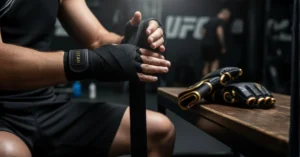
This may be the single most impactful long-term habit on this entire list, and it serves double duty — protecting your wrists during training and dramatically reducing glove contamination.
Hand wraps function as a sacrificial absorption layer. They capture the majority of sweat, skin oils, and shed skin cells before any of it contacts the glove interior. That biological material stays in the washable cotton or polyester fabric of the wrap — which you clean after every session — rather than soaking into your glove’s foam padding.
Washing hand wraps takes thirty seconds of effort. Place them in a mesh laundry bag, run a regular wash cycle, hang to dry. You’ve just removed the primary contamination source before it ever becomes a glove problem.
Fighters who consistently wear and wash their hand wraps report significantly reduced glove odor within one to two weeks, even without changing any other part of their gear routine.
Upgrade consideration: Moisture-wicking performance hand wraps pull sweat away from skin more aggressively than basic cotton. For fighters who sweat heavily or train in warm climates, this is a meaningful upgrade.
Pro Tip from the mat: Coaches consistently see the fighters with the freshest gear are the same ones who never train without wraps and wash them without fail after every session. The connection isn’t coincidental — it’s direct cause and effect.
Method 8 — Wipe Down After Every Session
Cost: $5–$10 for wipes | Difficulty: Easy | Impact: High
Sixty seconds. That’s all this takes. And it’s the single easiest high-impact change most fighters aren’t currently making.
Keep antibacterial wipes or a small microfiber cloth with diluted antimicrobial spray in your gym bag at all times. The moment training ends — before the gloves go anywhere — wipe the interior.
Priority zones:
- Palm area (highest sweat contact)
- Base of each finger channel (highest cell accumulation)
- Wrist strap interior lining
Wipe the exterior too, particularly after sparring sessions where mat contact, sweat transfer from partners, and any blood contact has occurred.
What to avoid: bleach wipes, harsh chemical cleaners not formulated for sports gear, and soaking the interior. You want cleaning moisture — not additional dampness that compounds the problem.
Method 9 — Use a Glove Dryer
Cost: $25–$60 | Difficulty: Easy | Impact: High (for frequent trainers)
Passive airflow works. Its limitation is speed.
Depending on training intensity and ambient conditions, gloves can take 12 to 24 hours to fully dry by passive hanging alone. That’s up to 24 hours of residual warmth and moisture actively supporting bacterial growth — even with deodorizer inserts present.
An electric glove dryer blows warm (not hot) air into the glove interior continuously, reducing full dry time to two to four hours. Some models incorporate UV sanitization during the drying cycle, adding another layer of bacterial reduction.
For fighters training four to six days per week, getting gloves genuinely dry between sessions is practically impossible without a dryer or very strong airflow. A dedicated dryer moves from “nice to have” to “necessary” at that training frequency.
Budget alternative: A small clip-on or desk fan pointed directly at your hanging gloves significantly increases drying speed without the investment. Not as fast as a dedicated dryer, but meaningfully better than passive hanging in still air.
Method 10 — Deep Clean Monthly
Cost: Minimal | Difficulty: Moderate | Impact: High (long-term)
Daily maintenance keeps the problem manageable. Monthly deep cleaning resets the baseline.
Once a month, run your gloves through a full interior and exterior cleaning process — see the step-by-step section below — that addresses any accumulated buildup that daily maintenance hasn’t fully reached, conditions exterior materials against cracking, and begins the next training month with gloves as close to fresh as achievable.
When monthly cleaning becomes more urgent:
- Training four or more sessions per week
- Regular sparring (more sweat, skin, and blood contact)
- Hot and humid training environments
- Sharing gloves with training partners
Daily Habit Routine to Prevent Glove Smell Permanently
Featured Snippet Target (Numbered List): After-training MMA glove care routine: (1) Remove gloves immediately after training. (2) Wipe interior with antibacterial cloth. (3) Spray interior and exterior with antimicrobial spray. (4) Open gloves palm-side out fully. (5) Insert deodorizer inserts. (6) Hang in ventilated area. (7) Never store in closed gym bag until completely dry.
Individual methods produce results. A consistent daily ritual eliminates the problem long-term.
Fighters whose gloves never seem to smell bad haven’t found a magic product. They’ve built a short post-training routine they execute automatically — the same way they wrap their hands before training without consciously thinking about it.
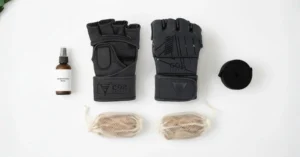
The Complete After-Training Glove Care Checklist:
| Step | Action | Time Required |
|---|---|---|
| 1 | Remove gloves immediately after training — don’t leave on during cooldown | Instant |
| 2 | Wipe interior with antibacterial cloth or wipe | 60 seconds |
| 3 | Spray interior and exterior with antimicrobial spray | 30 seconds |
| 4 | Allow spray to dry 2–3 minutes | Passive |
| 5 | Open gloves fully, palm-side facing out | 10 seconds |
| 6 | Insert deodorizer inserts | 10 seconds |
| 7 | Hang in ventilated area | 10 seconds |
| Total | ~5 minutes |
Never: store in a closed gym bag until completely dry.
Coach’s Note: The fastest way to build this into your routine is to attach it to something you already do. Set your gloves up while you do your post-training cooldown stretch. By the time your stretching is done, the spray has dried and you’re ready to hang them. It stops being a task and becomes part of training.
What NOT to Do With Smelly MMA Gloves
Featured Snippet Target: Do not machine wash MMA gloves — it destroys foam padding and stitching. Do not use bleach — it degrades materials and causes skin irritation. Do not store in a closed gym bag or hot car — it accelerates bacterial growth. Do not ignore persistent odor — bacteria embed deeper in foam over time, making the smell permanent.
Knowing what not to do prevents common mistakes that either fail to solve the problem or permanently damage your gear.
❌ Don’t Machine Wash MMA Gloves
The most common mistake — and genuinely destructive when done.
MMA gloves are constructed with bonded foam padding layers enclosed in leather or synthetic shell material. Machine washing subjects that construction to sustained mechanical agitation and deep water saturation it was never designed to handle. The foam padding delaminates, loses shock absorption properties, and the stitching and bonding adhesives fail.
Beyond structural damage, machine washing saturates gloves to a degree that requires days to fully dry — extending the warm, moist conditions you’re trying to eliminate. Most quality glove manufacturers explicitly void warranties for machine-washed gear.
Exception: If your specific gloves are marketed as machine washable, follow the manufacturer’s instructions precisely with cold water and a gentle cycle.
❌ Don’t Use Bleach or Harsh Chemical Cleaners
Bleach kills bacteria effectively. It also degrades leather fibers, brittles synthetic materials, dissolves bonding compounds, and — most critically — leaves residue inside the glove that causes significant skin irritation and potential chemical burns during your next training session.
Use products formulated specifically for sports equipment, or the natural DIY options described in this guide.
❌ Don’t Leave Them in Your Car or Gym Bag
Gym bags are warm, dark, closed environments. Car trunks in summer exceed 130–140°F (54–60°C) — hot enough to accelerate leather cracking and foam breakdown, but not hot enough or sustained enough for reliable bacterial sterilization.
The habit to build: gloves come out of the bag and get hung up the moment you arrive home. No exceptions, no “I’ll deal with it tomorrow.”
❌ Don’t Assume the Problem Will Improve on Its Own
Odor compounds, it doesn’t plateau. Bacterial and fungal colonies grow continuously when conditions allow. A smell that’s mild and fades overnight in week one becomes embedded and permanent in weeks four through six without intervention.
Early-stage odor is completely reversible with a few days of consistent care. Deeply embedded odor often isn’t, regardless of what you try.
How to Deep Clean MMA Gloves Step-by-Step
HowTo Schema Target — Materials + Steps:
What you’ll need:
- Mild liquid soap or sports equipment cleaner
- Two clean microfiber cloths
- Small bowl of warm water
- Antimicrobial spray
- Leather conditioner (genuine leather gloves only)
- Deodorizer inserts
Steps:
- Mix a small amount of mild soap into warm water in a bowl
- Dampen one microfiber cloth — wring until damp, not dripping wet
- Wipe all interior surfaces thoroughly: palm area, finger channels, wrist strap lining
- Pay particular attention to the base of each finger channel — highest accumulation zone
- Dampen the second cloth with plain water and wipe interior again to remove soap residue
- Wipe the entire exterior surface of both gloves with the damp cloth
- For genuine leather only: Apply a small amount of leather conditioner with a cloth, work in circular motions across exterior surfaces — skip for synthetic gloves
- Spray antimicrobial solution lightly inside each glove
- Insert deodorizer inserts immediately
- Hang palm-side out in a well-ventilated area
- Allow minimum 24 hours to fully dry before next training session
Why 24 hours matters: Training with gloves that haven’t fully dried after a deep clean introduces more interior moisture than a normal session. Schedule your monthly deep clean the night before a rest day when possible.
Best Products for Keeping MMA Gloves Fresh
You don’t need an expensive or complicated setup. The most effective combination is also the most affordable: a quality spray, deodorizer inserts, and hand wraps used consistently.
| Product Type | Primary Function | Frequency of Use | Priority Level |
|---|---|---|---|
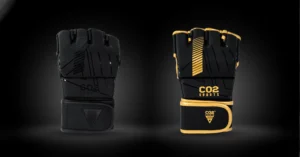
| CO2 Sports Titan MMA Gloves | Odor-resistant premium training gloves | Every session | 🔴 Essential |
| Antimicrobial spray | Kills bacteria on contact | After every session | 🔴 Essential |
| Glove deodorizer inserts | Absorbs moisture, neutralizes odor passively | After every session | 🔴 Essential |
| Hand wraps | Absorbs sweat before it enters glove | Every session | 🔴 Essential |
| Antibacterial wipes | Quick interior/exterior surface clean | After every session | 🟡 Recommended |
| Baking soda | Natural odor neutralizer | Weekly | 🟡 Recommended |
| Electric glove dryer | Reduces dry time to 2–4 hours | After every session | 🟡 Recommended |
| Leather conditioner | Prevents exterior cracking | Monthly | 🟢 Optional |
| Mesh laundry bag | For washing hand wraps | Every wash | 🟢 Optional |
Minimum effective setup for most fighters: antimicrobial spray + deodorizer inserts + hand wraps. These three, used consistently after every session, address the majority of glove odor problems without significant cost.
Conclusion
Smelly MMA gloves are not inevitable. They’re the predictable result of skipping a simple five-minute post-training routine — and they’re completely preventable once you understand what’s actually causing the problem.
The bacteria causing that smell need three things: warmth, moisture, and a dark enclosed space. Your job after every training session is to remove at least one of those conditions. Air the gloves out. Spray the interior. Insert deodorizer. Let them dry completely. Do that consistently, add a monthly deep clean, and your gloves will stay fresh, last two to three times longer, and stop being a concern in your gym.
The five minutes you invest in glove care after training is one of the most cost-effective gear decisions you’ll make. Quality MMA gloves aren’t cheap. The ones you already own are worth protecting.
Continue building your gear knowledge:
- How to Wrap Your Hands for MMA — Complete Beginner Guide — Hand wraps are your first line of defense for both glove hygiene and wrist protection during training
- MMA Glove Sizing Guide — How to Find Your Correct Fit — If your current pair is beyond saving, start here before purchasing your next gloves
- How Long Do MMA Gloves Last? Signs It’s Time to Replace Them — Know when to repair your routine and when to replace your gear entirely
- 4oz vs 7oz MMA Gloves — What’s the Difference and Which Do You Need? — Understanding glove weight helps you choose the right pair for training versus competition
- Best MMA Gloves for Beginners — Complete Buyer’s Guide — Everything worth looking for when purchasing your first pair of fight gloves
This article is part of our MMA Gear Education series — practical, research-informed guidance on combat sports equipment, training hygiene, and gear maintenance written for fighters at every level.


Pingback: Best MMA Gloves for Beginners: (Complete Guide 2026)